
What value-based pricing actually means for freelancers
Outcome-based pricing explained through real web designer and marketer proposals—what it is, what it isn't, and how to price it.

Updated on
2026-09-25
Outcome-based pricing explained through real web designer and marketer proposals—what it is, what it isn't, and how to price it.
Updated on
2026-09-25
Find the low-hanging, quick-wins and 10x your freelancing business!
Get the ChecklistPicture your last proposal.
Five pages. Homepage, about page, contact form, three rounds of revisions. A tidy little grocery list of everything you're going to build.
And then, way down at the bottom, in slightly nervous font size... the price.
You know the feeling. You stared at that number for twenty minutes wondering if it was too high. It wasn't. It was just naked. Sitting there next to a chore list, begging to be compared against the next freelancer's chore list.
Here's the thing nobody told you.
A task list turns you into a vending machine. Client puts in coins, page comes out. And vending machines compete on one thing only... who charges less for the same can of Coke.
This is where value based pricing walks in. As Benek Lisefski, a designer with 17 years behind him, puts it, value based pricing is still a fixed fee like project pricing. The difference is in how you arrive at and justify that fee.
Same fee. Different reasoning.
And the reasoning is everything. In one practical guide for freelancers, the example is blunt: if you're rebuilding an e-commerce site and the client expects a 20% revenue increase, that outcome is worth more than the hours you invest.
The hours don't move the client. The 20% does.
So the whole game is swapping your list of chores for the client's desired result. That's it. That's the mutation. Everything else in this article is just showing you the exact sentences.
Think about a mechanic.
Imagine one who hands you an invoice that reads: loosened 14 bolts, turned wrench 62 times, applied grease. And a price.
You'd laugh. You don't care how many times he turned the wrench. You care that your car starts when you turn the key.
That's your proposal right now. A list of wrench turns.
The client is standing in the parking lot going... but does it drive?
This is the myth that keeps freelancers broke: the belief that if you just prove you're skilled enough, list enough deliverables, show enough credentials, the client will happily pay. So you pile on the tasks. More pages, more features, more proof that you're worth it.
And the client still balks at the price.
Shannon Mattern, who runs the Web Designer Academy, nails why. When a client says it's out of their price range, the real reason is they can't see how parting with your fee today will help them create many times more than that later, not just in dollars but in time, capacity, and sanity.
Then she delivers the gut punch.
You assume they already know the value of a website, so you've been busy convincing them that you are worth it. But they're not looking for evidence that you're worth it.
They're looking for evidence that the result will be worth it.Big difference. Your credentials answer a question the client isn't asking. The outcome answers the one they are.
So stop selling the wrench turns. Sell the car starting.
Let's get concrete. Here's a designer's proposal before and after. Same project, same designer, two sentences apart.
Before, the scope line reads:
Tidy. Also a vending machine.
Now the after. Same designer, one outcome line, price sitting right behind it:
Notice what changed. The tasks are still in there somewhere, buried in an appendix where they belong. But the headline is a number the client's CFO would recognize.
And the price went up, not down.
This isn't wishful thinking. In three pricing conversations coached last month, the freelancer who moved from an hourly rate to a value anchor raised their per-project income by roughly two and a half times... on work that actually took less time.
I've watched this same swap play out with freelancers I work with, and the pattern is boringly consistent: the moment the fee sits next to a revenue number instead of a page count, the price objection quietly disappears. Nobody argues about $7,500 when it's standing next to $60,000.
Use a real, specific number too. Not "increase conversions." Say 1.8% to 3%. Say $60,000. Specific numbers feel researched and rational. Round, vague ones feel like you pulled them out of the air, which makes the client suspicious you did the same with your fee.
The outcome doesn't have to be a promise you'll get sued over. It's a target you're pointing at together. But it has to be measurable, or you're back to selling wrench turns.
Find the low-hanging, quick-wins and 10x your freelancing business!
Get the ChecklistMarketers have it worse, honestly. Their proposals read like a Vegas breakfast buffet.
Twelve social posts. Four blog articles. Two email sequences. One landing page. A partridge in a pear tree. And a fee at the bottom that the client mentally divides by the number of items to see if each one is "worth it."
Here's that buffet, before:
Every item is a wrench turn. And the client is doing the mental math on each one.
Now the outcome version:
The posts and emails still exist. They just got demoted from the headline to the machinery. Because the client never wanted 12 posts. They wanted the phone to ring.
The metric does the selling. 30 booked calls is something the client can picture, measure, and defend to their own boss. "Reporting and 4 articles" is not.
And the ceiling moves. According to 2026 freelance pricing data, freelancers using value based models earn an average of 42% more per project than those billing hourly. That gap isn't because they work harder. It's because they stopped pricing the wrench turns.
One more thing. Put the outcome first and the deliverables second, physically, in that order on the page. When the client reads the result before the parts list, the parts stop looking like an itemized bill and start looking like the engine under the hood.
Here's where people mess this up. They hear "value based pricing" and quietly do one of four things that are not value based pricing at all. Watch for these.
It is not guessing the client's budget. Sniffing around trying to figure out the biggest number they'll tolerate, then quoting that, is not outcome pricing. It's a shakedown with extra steps. The number should come from the result, not from your guess about their bank account.
It is not your hourly math wearing a costume. Taking your usual 40 hours times your rate, then writing it as a flat fee to hide the arithmetic, is still hourly pricing. You just turned off the lights. The client can smell it.
It is not a random project fee with no result attached. "Website: $5,000" is a flat fee, sure. But if there's no measurable outcome next to it, it's just a chore list with a total. The outcome line is the whole point.
It is not "charge what you're worth." That advice is a fortune cookie. Your worth isn't in the proposal. The client's result is.
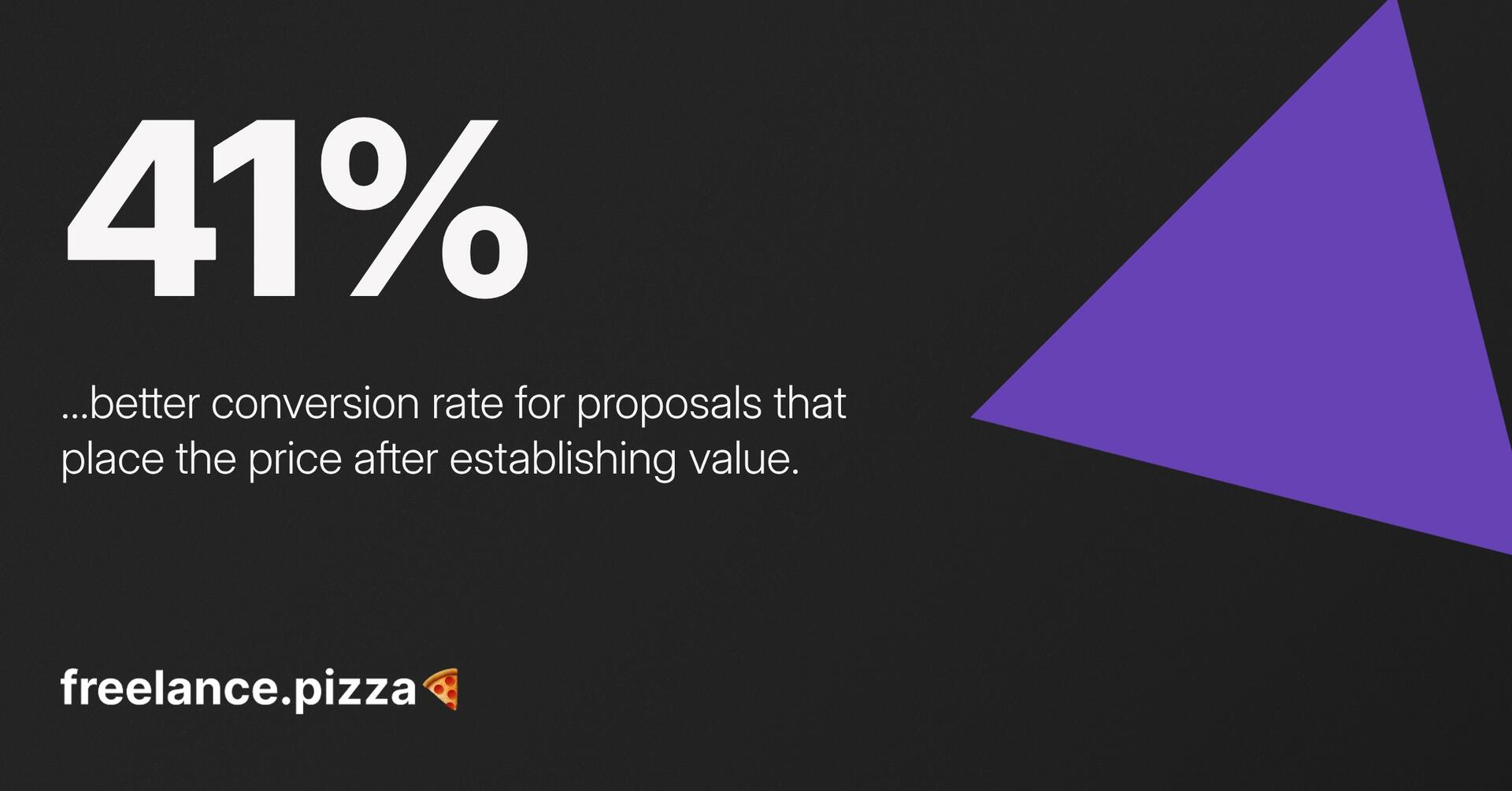
And the sequence matters more than you'd think. An analysis of 25,000 web design proposals by Proposify found that proposals placing the price after establishing value converted 41% better than the ones leading with cost.
Lead with the number, you're a vending machine. Lead with the outcome, you're the mechanic who gets the car running.
So do this tonight. Open your last proposal. Find the line that lists what you'll deliver, and rewrite it as the one measurable result the client actually wants. Then move your price so it sits right after that result, not at the bottom of a chore list. Fix those two sentences and stop losing on price.
Join 20.000+ freelancers in our weekly value bomb, and grow your frelance income with confidence!
By entering your email address you acknowledge to subscribe to the FreelancePizza mailing list.
You will be sent a confirmation (opt-in) email to confirm your email. You can unsubscribe any time.
