A business outcome is the money result a client actually wants: more revenue, lower cost, or saved time. You find it by asking four questions on every brief call. What does success look like? What is it worth per year? What happens if nothing changes? Who feels the pain? Then anchor your price to that number, not your hours.
The blind quote that leaves money on the table
Picture a vet who hears footsteps in the hallway and shouts out a surgery quote before the door even opens.
Could be a hamster.
Could be a Great Dane.
He has no idea, but he's already named a number. That's you, quoting a "redesign the site" brief off the top of your head.
Here's the thing. Your client walked in with a number already in their head. A real one. Tied to revenue, or cost, or hours they want back. And when you fire off an hourly rate before you know that number, you're guessing at an animal you haven't looked at yet.
Discovery is the looking. According to Responsive, client discovery information helps establish criteria, write customized questions, select vendors, score proposals, and make a final recommendation. It's the foundation for the entire process. Skip it and you're not pricing... you're wishing.
And the money you leave behind is not small. Haus Advisors puts a healthy price at 10% to 25% of the first-year value the work creates. That's the range where a client sees clear ROI without feeling robbed.
Do the math on that for a second.
If your work is worth $80,000 to their business this year, the "fair" number sits somewhere between $8,000 and $20,000. Quote it blind at your usual "$2,000 for a redesign" and you just handed them eighteen grand of upside for free.
You didn't lose it in negotiation.
You lost it before you opened your mouth.
The four questions that find the number
You don't need a fancy sales process. You need four questions, asked out loud, on every brief call, before you say a single price.
Here they are:
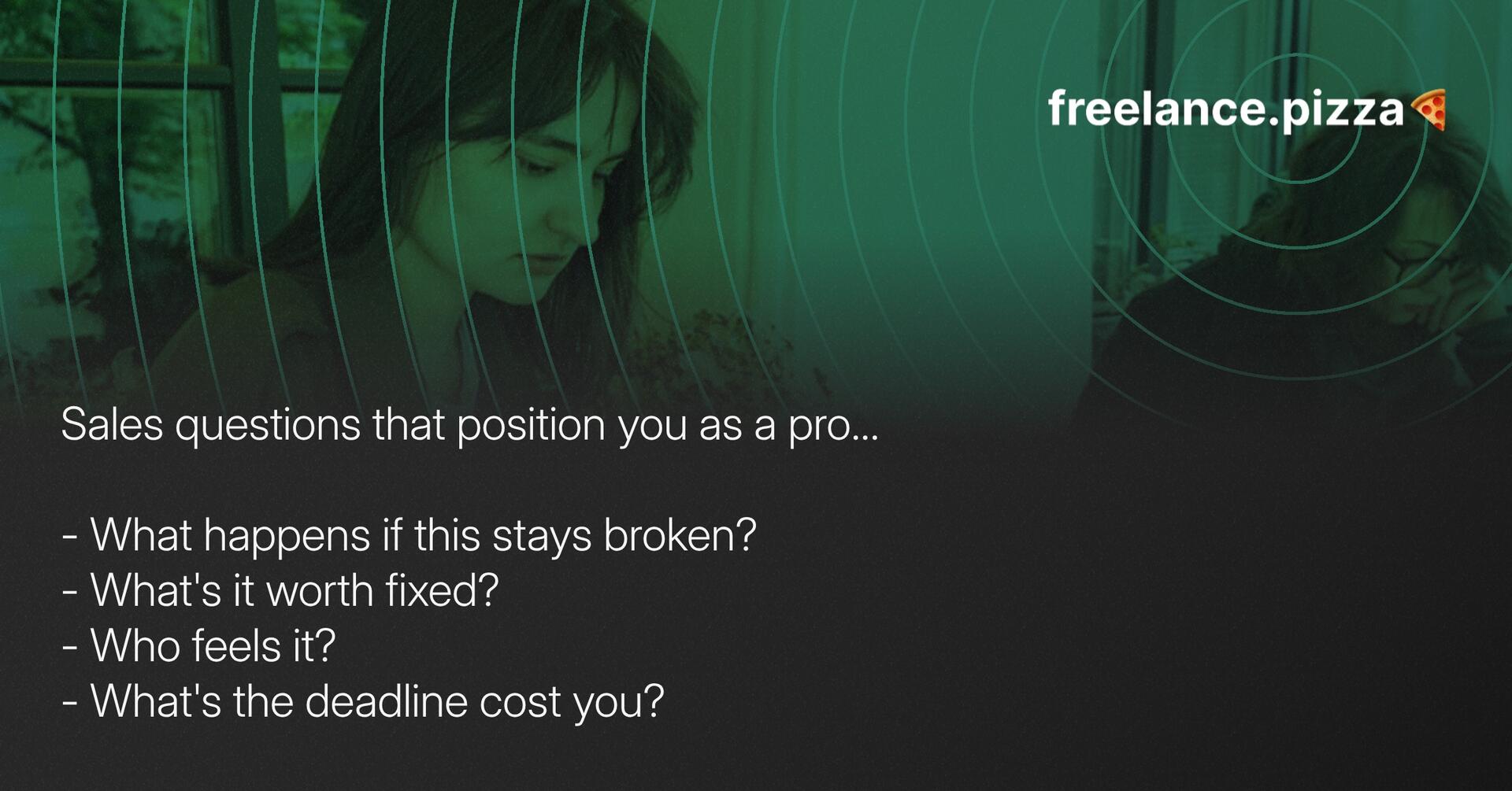
- What does success look like in a year? This drags the vague brief toward a concrete result. "A prettier site" becomes "more demo bookings."
- What is that worth to the business? This is the money question. You're getting to revenue, cost, or time. As the CFO Perspective channel puts it on YouTube, the tricky part is figuring out how much customers value something and where the price should sit between cost and value. Same problem here. You're finding value before you set price.
- What happens if you do nothing? The cost of the status quo. Sometimes it's bigger than the win.
- Who inside the company feels this pain most? This tells you whose budget you're really touching and how badly they want it solved.
The reason four questions is enough is that you're not trying to price your labor. You're trying to size their return. Consulting Success recommends your fee land somewhere that gives the client a 3X to 10X return on their investment. You physically cannot aim at that multiple until you know the value you're multiplying.
When I started freelancing I wrote 20 articles a day about copper sinks for a dollar each. Nobody ever asked me what those articles were worth to the client. I know now they were worth a lot more than a dollar. Four questions would have told me that in about six minutes.
Ask them. Then shut up and write down the number they give you.
Freelancing 101:
Get more clients with the Freelance Client Checklist
Find the low-hanging, quick-wins and 10x your freelancing business!
Get the ChecklistBrief one: "redesign our site"
A SaaS founder emails you. "We need the website redesigned. Can you send a quote?"
The old you sends "$2,500, three weeks." The vet quotes the hamster. Instead, you run the four.
How do you put a price on something when its value isn't tangible? That's the exact question Sushma K.U raised on LinkedIn, and it pulled 25 reactions because everyone feels it. The answer is you make the intangible tangible by asking.
- You: "A year from now, how do you know the redesign worked?" Them: "More people booking demos from the homepage."
- You: "What's a demo booking worth to you?" Them: "About 20% become customers, average customer is $4,000 a year."
- You: "How many demos does the site book now?" Them: "Maybe 10 a month. We think it should be 25."
- You: "What happens if you leave it as is?" Them: "We keep bleeding traffic that never converts."
Look what just happened. Fifteen extra demos a month is 180 a year. At 20% closing and $4,000 each, that's roughly $144,000 in new revenue. As Smart Insights frames it, discovery is what lets you tie anything you propose directly to what the client needs and their outcomes.
Now the price is not a guess. Haus Advisors' 10% to 25% band on that $144,000 puts you between $14,000 and $36,000. Anchor at $18,000 and it sounds rational, not inflated, because it's a fraction of the money you're printing for them.
Brief two: "write us four articles a month"
Same drill, different brief. A B2B company wants a content retainer. "Four blog posts a month. What's your rate?"
Rate-per-article thinking says $200 a post, $800 a month, done. That's copper sinks with a nicer coat of paint. Run the four instead.
- You: "What's the content supposed to do for the business?" Them: "Rank for buying-intent keywords and pull in qualified leads."
- You: "What's a qualified lead worth?" Them: "Our average deal is $12,000 and we close about 1 in 5 good leads."
- You: "How many leads would make this a win?" Them: "Even five extra qualified leads a month would be huge."
- You: "And if the blog stays quiet?" Them: "We stay dependent on paid ads that keep getting pricier."
Five qualified leads a month, closing one in five, at $12,000, is one deal a month. That's $144,000 a year of pipeline the content is feeding. Suddenly $800 a month looks like a rounding error.
The CFO Perspective channel on YouTube nails why this matters: pricing is a sharing of value between buyer and seller, and a sale only happens when both benefit. Price your retainer at a slice of that pipeline, say $3,500 a month, and both of you win. They net a fortune, you earn four times the per-article rate.
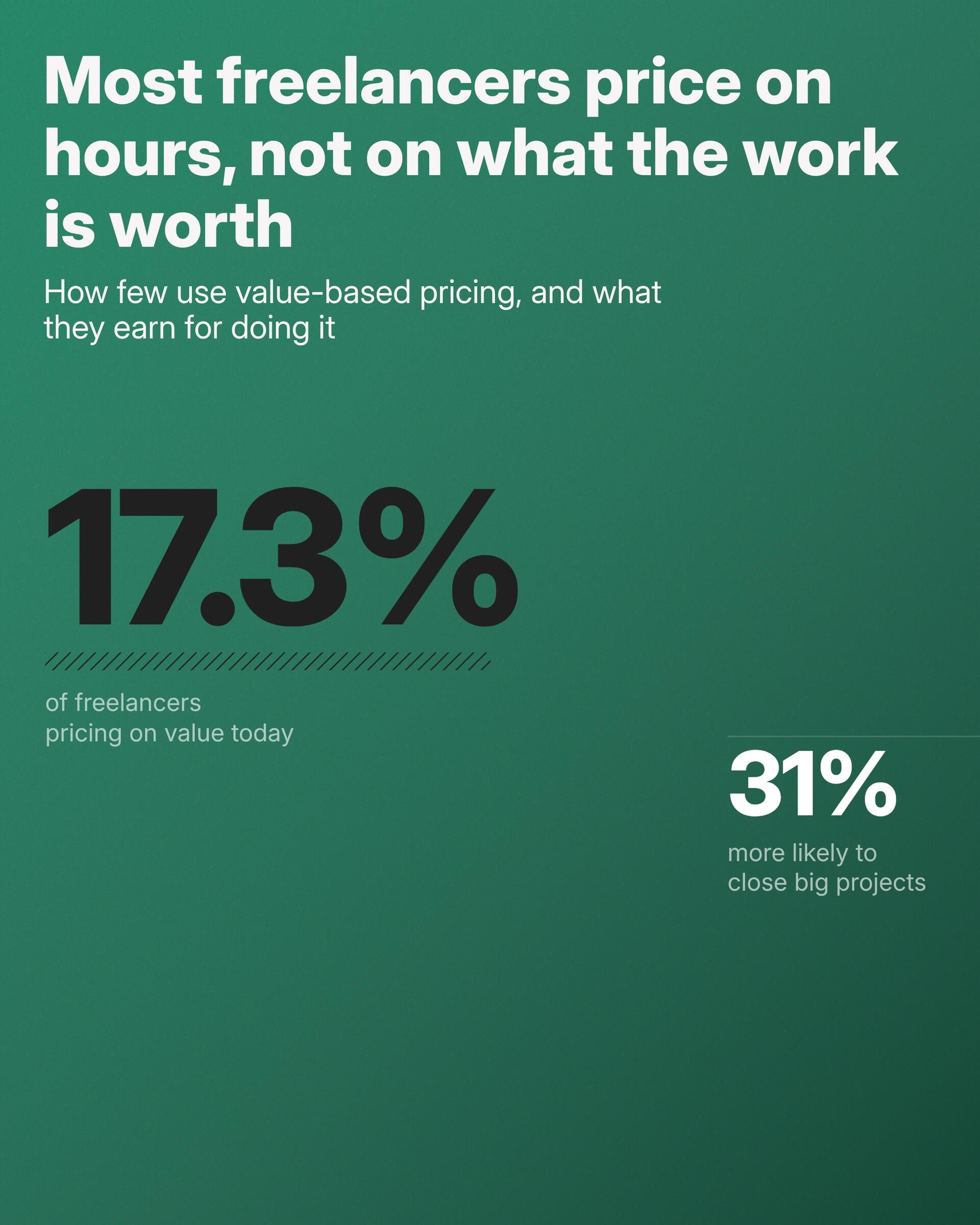
And there's a reason this is rare enough to be an edge. Consult Fees found only 17.3% of consultants use value-based pricing, yet that group is 31% more likely to close projects worth $10,000 or more. Most people are still quoting the hamster.
Brief three: "fix our checkout"
Last one, and the four questions cut fastest here because the money is right there on the surface. An ecommerce store says, "Our checkout leaks. Can you improve conversions?"
This is a conversion project, which Dave Chaffey describes as the knowledge-transfer stage before a pitch or at the start of a won project. So transfer the knowledge. Ask.
- You: "What does the checkout do now?" Them: "About 100 people start checkout a day, 40 finish."
- You: "What's an average order?" Them: "Around $90."
- You: "Where do you think that finish rate should be?" Them: "Industry standard is more like 55%."
- You: "What's it costing you to sit at 40%?" Them: "We honestly haven't done that math."
So you do it for them, right there on the call. Going from 40 to 55 completed orders a day is 15 more orders, at $90, that's $1,350 a day. Call it roughly $490,000 a year they are currently setting on fire.
You don't whisper your price after a number like that. You state it. "$40,000 to recover half a million dollars a year." That's under 10% of the win, and the client is nodding before you finish the sentence, because you handed them the math that makes it obvious.
That's the whole game. Three briefs, four questions each, and every single time the price stopped being a number you sweated over and became a number the client basically wrote for you. Run the four questions first and the price practically writes itself.
Key takeaways
- A business outcome is a money result: revenue gained, cost cut, or time saved. Quoting before you know it is like a vet quoting surgery before seeing the animal.
- Four questions get you there: what success looks like, what it's worth, the cost of doing nothing, and who feels the pain.
- Anchor to a slice of the value. Haus Advisors suggests 10% to 25% of first-year value, and Consulting Success suggests aiming for a 3X to 10X client return.
- It's a real edge. Consult Fees found only 17.3% of consultants price this way, yet they're 31% more likely to close deals over $10,000.
Frequently asked questions
What discovery questions should I ask clients to find their business outcomes?
Ask four on every brief call: what does success look like in a year, what is that worth to the business, what happens if you do nothing, and who feels the pain most. These pull a vague brief toward a concrete revenue, cost, or time number. Smart Insights notes discovery is what lets you tie your proposal directly to the client's actual goals.
How do I use value-based pricing to work out a client's ROI?
Turn the outcome into an annual dollar figure, then price a fraction of it. Consulting Success recommends your fee deliver a 3X to 10X return, and Haus Advisors suggests landing between 10% and 25% of first-year value. On a $144,000 gain, that's roughly $14,000 to $36,000, which reads as rational rather than inflated.
What upfront questions reveal a client's real business needs?
The four-question framework does it. Success in a year exposes the real goal, the worth question exposes the money, the do-nothing question exposes the cost of the status quo, and the pain question exposes whose budget you're touching. As the CFO Perspective channel puts it, a sale only happens when both buyer and seller benefit, so you need to size their benefit first.
Why not just quote my hourly rate and skip all this?
Because the client already has a number in their head tied to a business result, and your hourly rate is disconnected from it. Consult Fees found only 17.3% of consultants price to value, yet that group is 31% more likely to close bigger projects. Skipping discovery is the vet quoting surgery before the door opens.