Slow burn channels should be your default. A newsletter, SEO content and a LinkedIn presence keep paying after month six, while fast channels reset to zero every month. Fast channels only get a turn when rent is less than six weeks away, and even then, reactivate old clients and send cold email first. Upwork bidding loses on speed too: reply rates drop to 2.11% when crowded, and it eats 15 unpaid hours a week.
Six channels, one ring, and a rent bill
In the fast corner we've got platform bidding, cold email and reactivating old clients. All three promise money in days.
In the slow corner we've got a newsletter, SEO content and a LinkedIn presence. They take months to warm up... and then they keep paying.
Most freelancers split their week between both corners and wonder why neither one works.
Twenty minutes later, the client hired a team that bid $220 total. Full delivery in 48 hours.
$220.
For three weeks of work.
That's Upwork bidding: a pigeon fighting forty other pigeons for one crumb. And the crumb goes to whichever pigeon will eat it for free.
When people ask me about bidding, I give them the same answer every time. "It's just a grind. You don't get real jobs there."
Sure, it pays off once in a while if you're stubborn and consistent. Once in a while.
So before we score anything, here's the only question that matters: is rent less than six weeks away? If yes, go fast. If no, build slow. The four rounds below show you why.
Fast channels vs slow channels
Channel
Camp
Time to first client
Money potential
When to use it
Old clients
Fast
Days
💰💰
Rent under six weeks
Cold email
Fast
30 to 60 days to fill a pipeline
💰💰💰
Rent under six weeks
Upwork bidding
Fast, in theory
Rarely lands; 2.11% replies when crowded
💰
Last resort
Newsletter
Slow
Months
💰💰💰💰
Default
SEO content
Slow
3 to 6 months, sometimes 6 to 12
💰💰💰💰💰
Default
LinkedIn presence
Slow
Months
💰💰💰💰
Default
The speed round, where bidding should win and doesn't
You'd think bidding takes the speed round easily. It's the whole sales pitch, right?
Nope.
Old clients win this round. They already know you, they already trust you, and they already have your invoice in their accounting software. You send one friendly email to someone who has paid you before, and that's the fastest money in freelancing.
"I helped a similar studio cut its onboarding time in half last spring."
Your version: "I helped a similar [client type] [measurable result] [when]."
And bidding? It barely shows up for the round.
GigRadar pipeline data covering 59,339 proposals across 30,964 Upwork jobs found reply rates fall from 9.44% when one GigRadar team bids a job to 2.11% when 11 or more do. And 67% of their proposals landed on a job that another GigRadar customer had also bid.
So the "hot" job your scanner flags is a worse job, because everyone else's scanner flagged it too. Forty pigeons. One crumb. You know how this ends.
Fifteen hours a week of unpaid writing
Now let's talk about what bidding costs you. Grab a snack, this one hurts.
Nobody pays you for those hours. It's basically a second part-time job where the salary is... hope.
Then come the fees. Over 24 months he paid Upwork $14,230. That's what he paid for the privilege of losing to $220 bids. I read that number twice and felt a little sick for him.
Here's his bidding reality in one place:
Now picture those 15 hours going somewhere else. Fifteen hours a week gets you a couple of SEO articles. Or a newsletter issue and a few LinkedIn posts. Or a stack of cold emails to people who actually fit your skills.
That work keeps its value. A proposal nobody opened disappears the minute the client hires someone else.
Bidding loses the cost round by a mile. It isn't even close. The pigeon spent all day flapping and went home with nothing.
Freelancing 101: Get more clients with the Freelance Client Checklist
Find the low-hanging, quick-wins and 10x your freelancing business!
Bidding reality from one freelancer's final stretch on Upwork
What he measured
Number
Proposals sent in final six months
317
Response rate
3.4%
Hours a week writing proposals
15, unpaid
Platform fees over 24 months
$14,230
Small crumbs keep you a small bird
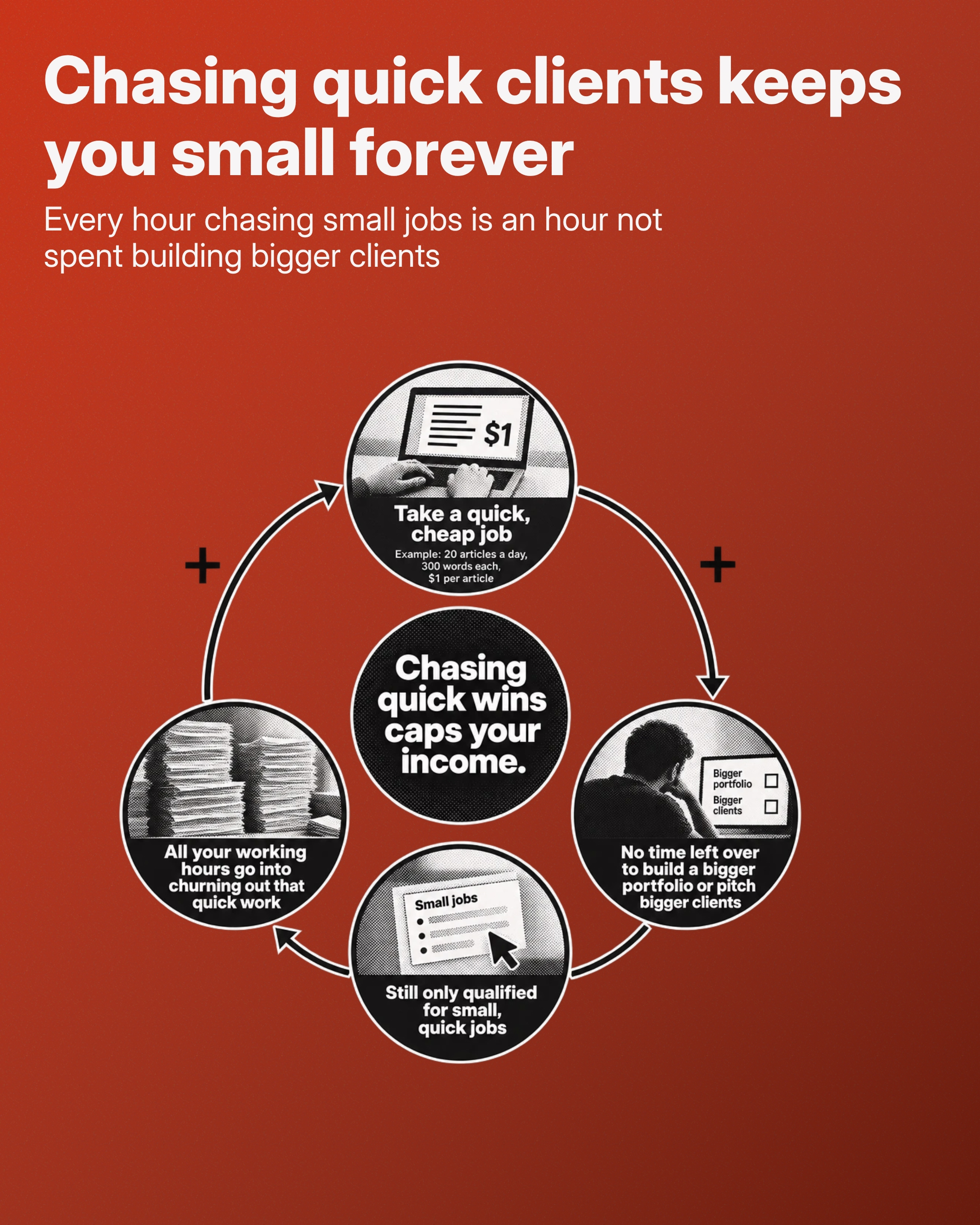
This round is the fast-win trap, and it's the one that quietly decides your income.
When you chase quick clients in a loop, you get quick-client money. Small jobs, small budgets, small portfolio. And that loop eats the exact hours you'd need to build a bigger portfolio and go after bigger clients on bigger platforms.
My first "writing job" was 20 articles a day about copper sinks. 300 words each, one dollar per article. I kept telling myself it would get better. It didn't, really. I just kept landing more of the same bottom-of-the-barrel stuff and never got anywhere near financial freedom.
So he quit cold turkey. No more Connects, profile turned off. His first week of cold email got zero opens and zero replies. Within 60 days, his monthly revenue went from an inconsistent $3,200 to $18,430.
Here's how the six channels compare on time to first client and when to use each one:
Month six, when the slow camp starts cashing checks
Three months of writing into the void. I won't pretend that's fun. It feels like shouting at a very polite wall.
But watch what happens around month six.
The article you wrote in month one is still pulling in readers. Your newsletter list is bigger than it was last month and bigger than it was the month before. Your LinkedIn posts keep putting your name in front of people who might need you next quarter.
Everything stacks.
Fast channels do the opposite. Every month resets to zero. A won bid doesn't make the next bid easier. The client who replied to your cold email in March won't bring in April's client by magic. You're back out hunting, you know, forever.
Darren Hardy puts the formula plainly in his book The Compound Effect: "Small, Smart Choices + Consistency + Time = RADICAL DIFFERENCE."
Very inspiring. Also a little annoying, because "time" is the part nobody wants to hear.
Still, the slow camp wins every round that runs longer than a month. And a freelance income is decided over years, so those are the rounds that count.
Fast camp vs slow camp, all four rounds
Round
Fast camp
Slow camp
Winner
Speed
Old clients and cold email land work first; bidding drops to 2.11% replies
Months before the first lead
Fast camp, minus bidding
Cost
15 unpaid hours a week; $14,230 in fees
Time up front, no platform cut
Slow camp
Client size
$220 jobs and a 20% cut
Room to build toward bigger clients
Slow camp
Six months
Resets to zero every month
SEO pays from month three to six
Slow camp
The scorecard and the one rent rule
Four rounds. Here's how they shook out:
Fast wins round one. Then it loses every round that decides your income.
So here's the rule, and it's a short one.
If rent is less than six weeks away, go fast. Email your old clients today, then send five well-researched cold emails a week. Skip the bidding pile if you possibly can.
In every other case, build slow. Newsletter, SEO content, LinkedIn. Treat these as your default, and treat the fast channels as an emergency tool.
And the pigeon? Let it keep fighting the other forty for that crumb. You've got better things to do with fifteen hours a week.
Feed the rent this month, then go plant something that grows.
Key takeaways
Slow burn is the default. A newsletter, SEO content and a LinkedIn presence compound past month six, while fast channels reset to zero every month.
The rent rule decides it. Go fast only when rent is less than six weeks away. In every other case, build slow.
Bidding loses even on speed. GigRadar data shows reply rates falling from 9.44% to 2.11% once 11 or more teams bid the same job.
When you need cash, start with old clients and cold email. A single proof line naming a measurable result for a similar client roughly doubled one copywriter's reply rate.
Quick wins keep you on small jobs. Fifteen unpaid proposal hours a week is time you could spend building toward bigger clients.
Frequently asked questions
Upwork or cold outreach: which is better for freelancers?
Cold outreach wins. One freelancer sent 317 Upwork proposals at a 3.4% response rate and spent 15 unpaid hours a week on them. After he switched to cold email, his monthly revenue went from $3,200 to $18,430 within 60 days.
What are the best Upwork alternatives for freelancers?
If rent is less than six weeks away, reactivate past clients and send cold email. Otherwise, put your hours into a newsletter, SEO content and a LinkedIn presence, since those keep paying long after you do the work.
How long does SEO take to bring in freelance clients?
SEO.com puts it at three to six months to start seeing leads or sales, and six to twelve months in some cases. That's slow, but an article you write once keeps working, while a bid is dead the moment the client hires someone else.
How many cold emails should a freelancer send each week?
Self Employed's cold-email guide says five well-researched emails a week over 30 to 60 days can fill a pipeline. Add one line naming a measurable result for a similar client, for example "I helped a similar [client type] [result] [when]."
Is Upwork bidding ever worth it?
Occasionally, if you're consistent, but it's a grind that rarely lands real jobs. Popular postings attract crowds of bidders, and reply rates fall to 2.11% when 11 or more teams go after the same job.
Join 20.000+ freelancers in our weekly value bomb, and grow your frelance income with confidence!
By entering your email address you acknowledge to subscribe to the FreelancePizza mailing list. You will be sent a confirmation (opt-in) email to confirm your email. You can unsubscribe any time.