You know that feeling when it's 4 PM and you realize you've spent the entire afternoon scrolling job boards instead of actually working? We all pretend it's just a quick 10-minute break. Turns out, we're all pretty good at lying to ourselves.
Most freelancers tell themselves job hunting only takes a few minutes a day. The truth? Those "few minutes" are quietly stealing tens of thousands of dollars from your annual income. And you probably haven't even noticed.
Here's What's Actually Happening
Let's be honest. You're probably doing one or more of these things right now:
You think job hunting only takes a few minutes daily. Scroll, apply, check email. Done. Spoiler: it's not.
You believe passive job hunting works better than actively searching. Why tire yourself out when opportunities come to you, right?
You're convinced you need to be everywhere at once. LinkedIn, Upwork, niche boards, your own website. More platforms mean more chances, right?
You tell yourself this scattered approach is just part of being a freelancer. Everyone does it. It must be normal.
You're pretty sure the time adds up, but not that much. It's probably just a couple hours a week. How bad could it be?
All five of these beliefs are costing you serious money. Let's break down why.
Myth #1: Job Hunting Only Takes a Few Minutes a Day
This one feels true when you're living it.
Clockify's research found that freelancers dedicate 4:30 to 5:00 PM every single day to client and job search activities. That includes scrolling job boards, writing pitches, checking emails, and promoting your services.
Here's the sneaky part: you don't count this time. There's no clock running. Nobody's billing you. So it vanishes.
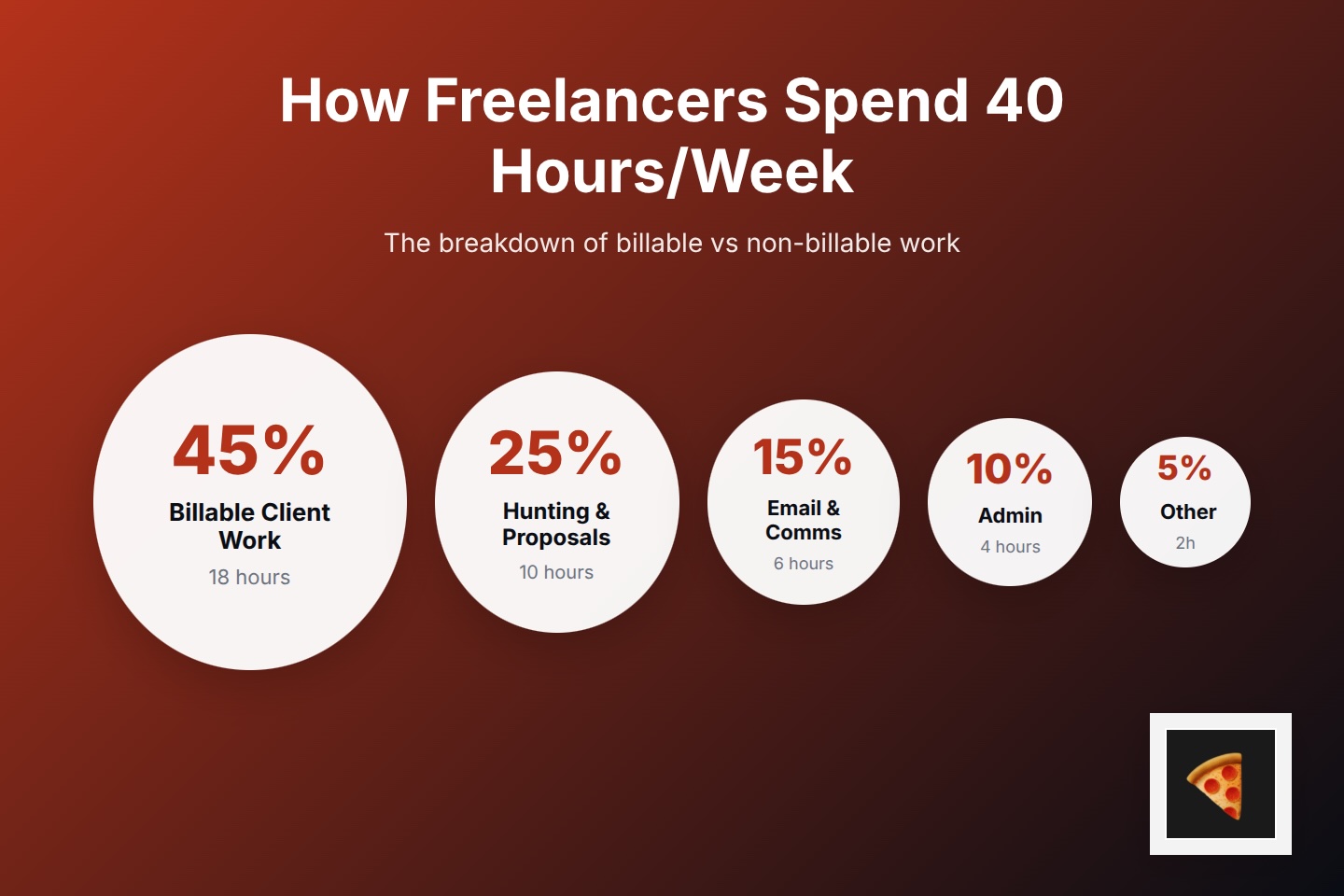
Passport Photo's research tells a different story. Freelancers spend roughly 5 hours per week on non-billable tasks. That's the conservative number.
Add in time refinishing pitches, following up on applications, navigating platform interfaces, and sorting through unsuitable leads? You're looking at closer to 10 hours per week for many freelancers.
That's two full workdays. Every single week.
Myth #2: Passive Job Hunting Works Better Than Active Searching
Here's where the data gets interesting.
According to Passport Photo's research, 62% of freelancers find projects through passive methods (waiting for clients to reach out). The other 38% rely on active outreach.
Sounds like passive is winning, right? You can sit back and let the work find you.
Except there's a problem.
When 62% of freelancers are sitting around waiting passively, your inbox looks like everyone else's. Quiet. Empty. Clients are fishing in the same pond, watching the same 38% of active freelancers compete for attention.
The research doesn't tell us which method generates consistent income. Passport Photo notes that roughly 64% of freelancers complete only two to five projects per year. That's not consistent work. That's the feast-or-famine cycle most of you know too well.
Passive waiting leaves you vulnerable to dry spells.
Freelancing 101:
Get more clients with the Freelance Client Checklist
Find the low-hanging, quick-wins and 10x your freelancing business!
Get the ChecklistMyth #3: You Need to Be on Every Platform to Find Work
Let's talk about spreading yourself too thin.
Clockify's research shows that 70% of freelancers find jobs via online marketplaces. That's a lot of people concentrated in Upwork, Fiverr, and similar sites.
But here's the catch: being on every platform doesn't mean you find more work. It means you divide your attention across more places.
Each platform has its own interface. Its own application format. Its own messaging system. Each one takes time.
If you're splitting your energy between LinkedIn, Upwork, niche industry boards, your own website, email outreach, and Twitter, you're not 6 times more effective. You're 6 times more scattered.
More platforms don't equal more work. Focused effort on fewer platforms usually wins.
Myth #4: The Time You Spend Job Hunting Doesn't Really Add Up
This is where the math gets uncomfortable.
Let's say you spend 5 hours per week job hunting (the conservative estimate). That's 260 hours per year.
If you charge $50 to $150 per hour as a freelancer (depending on your skill set), those 260 hours represent somewhere between $13,000 and $39,000 in lost income.
If you're spending 10 hours per week instead? Double that number.
According to DemandSage's 2026 freelance workforce data, full-time freelancers work an average of 43 hours per week. If you're spending 10 of those hours hunting instead of billing, that's nearly 23% of your working time.
Think about that differently: you're working roughly one full day every week for free. Just searching.
Over a year, that's more than 10 weeks of unpaid labor.
Suddenly it adds up.
Myth #5: The Feast-or-Famine Cycle Is Just How Freelancing Works
Here's what we know from Passport Photo's research: roughly 64% of freelancers complete only two to five projects per year. That's inconsistent income. That's the stress of not knowing when the next paycheck arrives.
Now here's the uncomfortable part: the feast-or-famine cycle is often caused by how most freelancers search for work.
When you're passive, you get feast (a client finds you and you're busy) or famine (nobody's looking and you're idle). When you're reactively searching on platforms, you're competing with thousands of other people for the same visible jobs.
DemandSage's research notes that most freelancers find it difficult to find enough work. That difficulty is real. But it's not inevitable. It's often a symptom of the search method itself.
If you're spending your job-search time reactively scrolling and applying, you're competing on volume. If you're strategic and focused, you're competing on fit.
The Real Pattern Here
Notice what connects all five myths?
They all rely on the same flawed assumption: job hunting is something you have to tolerate. It's painful, it's time-consuming, it's inefficient, but there's no way around it.
That assumption is wrong.
According to Clockify and Passport Photo's research, these myths persist because freelancers don't track their non-billable time. It happens in the gaps between "real work." It's invisible, so it feels less important.
But invisible doesn't mean harmless. Invisible costs money.
What This Means for You
If you're a web designer, developer, copywriter, or digital marketer spending 5 to 10 hours per week hunting for work, you're watching tens of thousands of dollars walk out the door.
More importantly, you're teaching yourself a terrible habit: that finding work is just part of the grind. That there's no way to compress those hours.
The research suggests something different. The problem isn't that job hunting is impossible to optimize. The problem is that most freelancers approach it the wrong way.
Spreading effort across multiple platforms. Passive waiting mixed with desperate active outreach. Manual scrolling and clicking and hoping. Following up on unsuitable leads that waste time.
All of this eats hours. All of this could be compressed.
The freelancers who escape the feast-or-famine cycle aren't special. They're just more strategic about where they hunt and how they hunt.
They're not hunting harder. They're hunting smarter.
And they're reclaiming those 520 hours for the work they actually love.
Sources cited in this article:
DemandSage Freelance Statistics: https://www.demandsage.com/freelance-statistics/
Clockify Time Tracking Research: https://clockify.me/how-freelancers-spend-time
Passport Photo Freelance Statistics: https://passport-photo.online/blog/freelance-statistics/