You know that Sunday night feeling when you realize you've spent 12 hours this week scrolling through job boards? Yeah, that one.
Most freelancers burn 10+ hours weekly hunting for work across multiple platforms. That's more than a full workday you could spend actually making money. The platform you pick determines whether you're responding to quality leads or throwing proposals into the void.
Choose wrong and you'll find yourself in feast-or-famine hell. You'll compete against 200 other freelancers for a $500 project while the good clients slip away. Choose right and you'll land higher-value projects with less competition and more predictable income.
Let's figure out which platform actually converts for web designers, developers, and content writers in 2025.
The Verdict (Before You Read 1,500 More Words)
Here's what each platform delivers right now:
| Platform | Time-to-First-Hire | Average Project Value | Competition Level | Best For |
|---|
| Upwork | 1-2 weeks | Varies by service | Highest (many proposals per job) | Speed and volume |
| LinkedIn | 1-3 months | $3,000-$10,000+ | Medium | Premium clients and long-term relationships |
| Niche Boards | 2-4 weeks | Platform-dependent | Lowest | Specialized skills and targeted audiences |
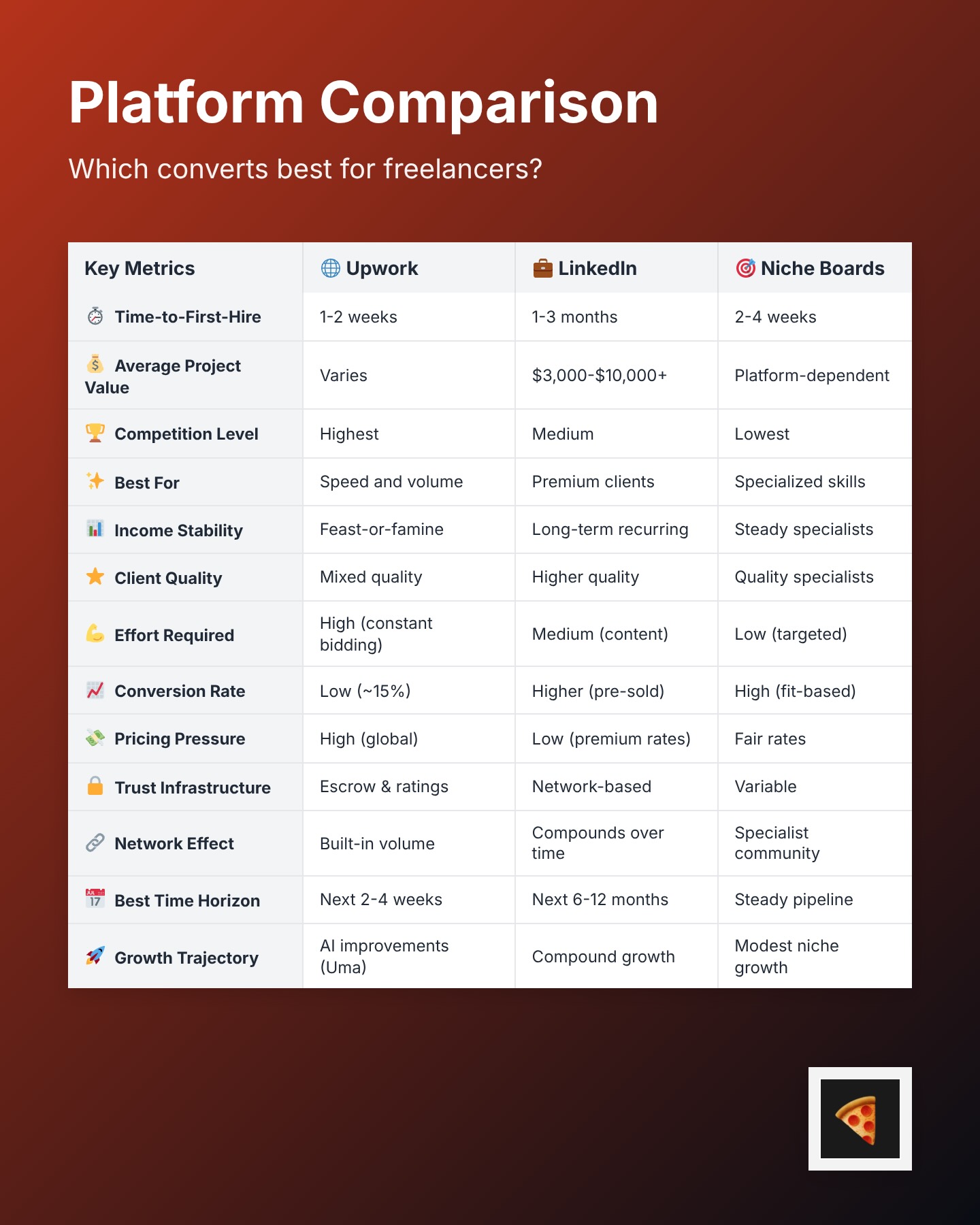
According to LiGo Social's June 2025 analysis, LinkedIn produces higher-value leads but takes longer to convert. Upwork gets you paid faster but throws you into brutal competition.
The "best" platform depends on whether you need cash next week or clients next year. You probably need both, which is why this gets complicated.
What "Converts Best" Actually Means
Before we pit these platforms against each other, let's define what we're measuring.
Conversion rate means the percentage of your pitches that turn into paid projects. If you send 20 proposals and land 3 projects, that's a 15% conversion rate. This matters because your time is money. Spending hours on dead-end pitches is the fastest way to hate freelancing.
Average project value determines whether you can pay rent with one client or need ten. Higher-value projects reduce those feast-or-famine cycles that keep you up at 2am refreshing job boards.
Competition level shows how many other freelancers you're fighting for each opportunity. More competition means faster response times and lower prices to stay competitive.
Time-to-hire tracks days or weeks from when a job posts to when you get your first response. Critical if you need consistent income flow instead of waiting three months between projects.
Quality of fit measures how well the platform's matching system aligns opportunities with your actual skills. This reduces time wasted on unsuitable leads that were never going to convert anyway.
Platform growth trajectory tells us where things are headed. Mordor Intelligence's September 2025 report shows the freelance platform market growing at 16.66% annually through 2030. It will reach $16.54 billion. That growth isn't distributed equally across platforms.
These metrics directly address the core pain points for intermediate freelancers: wasted time, unpredictable income, and low-quality leads.
Upwork: The Speed Demon With a Competition Problem
Upwork gets you in front of clients fast. Really fast.
According to LiGo Social's research, you can land your first client within 1-2 weeks of starting on the platform. That timeline matters when you're staring at an empty calendar and shrinking bank account.
The competition level is brutal. Upwork's global marketplace means you're bidding against freelancers from countries with much lower cost of living. This creates constant downward pricing pressure. You'll watch perfectly good projects go to someone willing to work for less when you quoted your actual rate.

Here's where Upwork got smarter. Mordor Intelligence reports that Upwork earned $769.3 million in 2024 and launched Uma, an AI-powered proposal assistant. Uma helps match freelancers to better-fit opportunities and improves proposal quality. This means the platform is getting better at quality of fit, even if competition stays fierce.
Strengths: Volume of opportunities, speed to first hire, built-in escrow and payment protection, algorithmic visibility for new freelancers who haven't built networks yet.
Weaknesses: Race-to-the-bottom pricing from global competition, high rejection rates on proposals (seriously, prepare for soul-crushing silence), requires constant bidding effort instead of relationship building.
Upwork works best when you need income this month and can afford to play the numbers game. Send many proposals, land some projects, survive another quarter. It's not romantic, but it pays bills.
LinkedIn: The Long Game That Actually Pays Off
LinkedIn operates on a completely different timeline and philosophy.
LiGo Social's comparison shows LinkedIn takes 1-3 months of consistent effort before you see results. That's 1-3 months of posting content, engaging with your network, and building visibility before quality leads show up in your DMs.
But here's the payoff: average project values run $3,000-$10,000+ according to LiGo Social. LinkedIn clients are typically hiring for longer-term relationships, not one-off projects. They're looking for strategic partners, not task completers.
Competition levels sit somewhere in the middle. You're not competing against hundreds of proposals, but you are competing against everyone else creating content in your space. The difference is that competition happens through relationship building rather than price wars.
Time-to-hire is where LinkedIn loses points for immediate needs. That 1-3 month timeline is real. You can't start on LinkedIn Monday and land a paid project Friday. You need to publish valuable content, engage authentically, and build credibility before decision-makers trust you with their budget.
Conversion rates depend entirely on how well you've built your personal brand. Cold outreach on LinkedIn converts poorly. But warm inbound leads from people who've followed your content convert at much higher rates because they're pre-sold on your expertise.
Strengths: Higher project values, better client quality, builds long-term relationships instead of transactional gigs, positions you as expert rather than vendor, compounds over time as your network grows.
Weaknesses: Slow to generate results, requires consistent content creation (which is work itself), doesn't help if you need money next week, success depends heavily on your ability to create valuable content and engage strategically.
LinkedIn makes sense when you're thinking 6-12 months ahead. It's an investment in future income stability, not a solution for current cash flow problems. Which is why most freelancers should use both platforms strategically.
Niche Boards: The Specialist's Secret Weapon
Niche job boards sit in an interesting middle ground that most freelancers ignore.
Grand View Research's September 2025 analysis shows the freelance platform market includes specialized platforms like 99designs for designers, Toptal for elite developers, and hundreds of industry-specific boards. These platforms collectively make up a growing segment of the $5.58 billion global market projected to reach $14.39 billion by 2030.
Time-to-hire typically runs 2-4 weeks. You'll move faster than LinkedIn but won't see the instant activity of Upwork.
Competition levels are dramatically lower than Upwork. Niche boards attract fewer freelancers because most people stick to the big platforms they already know. Less competition means your proposals get more attention and you face less pricing pressure.
Average project values vary wildly depending on the platform. Design-specific boards often command premium pricing because clients there understand the value of specialized work. Generic niche boards may offer similar rates to Upwork.
Quality of fit is where niche boards shine. If you're a specialized WordPress developer, a WordPress-specific job board will have dramatically better fit than general platforms. You won't compete against full-stack developers and designers for the same gigs.
The challenge with niche boards is finding the right ones for your specialty. There's no universal directory, and quality varies dramatically. Some boards are thriving communities with engaged clients. Others are digital ghost towns with three-month-old postings.
Strengths: Lower competition, higher quality of fit for specialists, often connects you with clients who understand your niche's value, builds specialist reputation faster than generalist platforms.
Weaknesses: Lower overall volume, requires research to find quality boards in your niche, many boards lack the trust infrastructure (escrow, ratings, dispute resolution) of major platforms, some have annual membership fees.
Niche boards work best when you have a clear specialty. They shouldn't be your only source, but they can be your best source for high-fit opportunities.
When to Use Each Platform (The Part You'll Actually Use)
Here's the honest breakdown based on your situation:
Use Upwork when:
- You need income within the next 2-4 weeks
- You're building initial freelance experience and portfolio
- You can handle high rejection rates without losing motivation
- You're willing to play the numbers game (send many proposals, land some projects)
- You need the trust infrastructure of escrow and ratings for client security
Use LinkedIn when:
- You can invest 1-3 months before seeing financial returns
- You're comfortable creating regular content in your niche
- You want to build long-term client relationships and recurring revenue
- You're targeting higher-value projects ($3,000+)
- You can authentically engage with your network without feeling gross about networking
Use niche boards when:
- You have a clear specialty (not "web designer" but "SaaS landing page designer")
- You've identified 2-3 quality boards where your ideal clients post jobs
- You want less competition and better-fit opportunities
- You're willing to pay membership fees if the board requires them
- You can supplement them with other platforms (they rarely provide enough volume alone)
The hybrid approach (what most successful freelancers actually do):
- Use Upwork for immediate cash flow and building your rating
- Invest time in LinkedIn for future high-value relationships
- Monitor 1-2 niche boards for perfect-fit opportunities
- Gradually shift from Upwork volume to LinkedIn relationships as your pipeline fills
Mordor Intelligence's data shows that web and graphic design segments are growing at 19.17% annually through 2030. That growth is happening across all platforms. But the distribution is shifting toward platforms with better AI-powered matching and quality control.
The Real Problem (And Why Platform Choice Isn't Enough)
Here's the part where I tell you something you probably already know but don't want to hear: the platform matters less than your system.
Spending 10+ hours weekly hunting across multiple platforms is the problem. It doesn't matter if Upwork gives you quick wins and LinkedIn delivers higher-value clients if you're burning your entire Sunday scrolling through job boards.
The math is brutal. If you spend 10 hours weekly on job hunting at a $75/hour opportunity cost, you're losing $3,000+ monthly to the search process. That's before you count the time spent writing custom proposals that go nowhere.
The freelancers winning right now have automated or systematized their lead generation. They're not manually checking three platforms daily. They've built systems that surface opportunities, pre-qualify fits, and reduce the time from opportunity to pitch.
That might mean hiring a VA to monitor boards and flag opportunities. It might mean using automation tools to aggregate and filter opportunities. Or it might mean building your LinkedIn presence to the point where quality leads come to you instead of you hunting them.
But the platform comparison is only step one. Step two is building a system that doesn't consume half your working hours just to stay visible to potential clients.
The freelance platform market is growing at 16.66% annually. That's good news for freelancers overall. But it also means more competition, more noise, and more time required to stand out.
Choose your platforms based on your current needs and 6-month goals. Then build a system that keeps job hunting from becoming your actual full-time job.
Because the best platform is the one that gets you back to doing the work you actually enjoy.