
What to Do When a Client Doesn't Pay: A Freelancer's Action Plan
Learn the 6-step system to collect overdue payments from clients. Professional follow-up, demand letters, and legal escalation strategies for freelancers.

Updated on
2026-02-05
Learn the 6-step system to collect overdue payments from clients. Professional follow-up, demand letters, and legal escalation strategies for freelancers.
Updated on
2026-02-05
Find the low-hanging, quick-wins and 10x your freelancing business!
Get the ChecklistYou just sent an invoice for $2,500 of work you finished last week. It's now 15 days overdue. Your client isn't responding to messages. Your rent is due in two weeks.
This is the moment where most freelancers either panic or give up. But you're going to do something else: follow a system.
Non-payment is one of the top income stability threats for solopreneurs. It feeds that feast-or-famine cycle you're probably tired of experiencing. Most freelancers delay action because they don't know what steps are actually legal and effective.
According to Alfa Law Firm, having well-drafted contracts and clear action plans prevents payment disputes from becoming crises. The good news? You can transform non-payment from a devastating crisis into a manageable problem with predictable next steps.
This guide is for intermediate freelancers (developers, designers, writers, marketers) who spend more time hunting for work than they'd like. If you've got 2-5 years of experience and earn a decent chunk of your income from freelancing, this is for you.
Find the low-hanging, quick-wins and 10x your freelancing business!
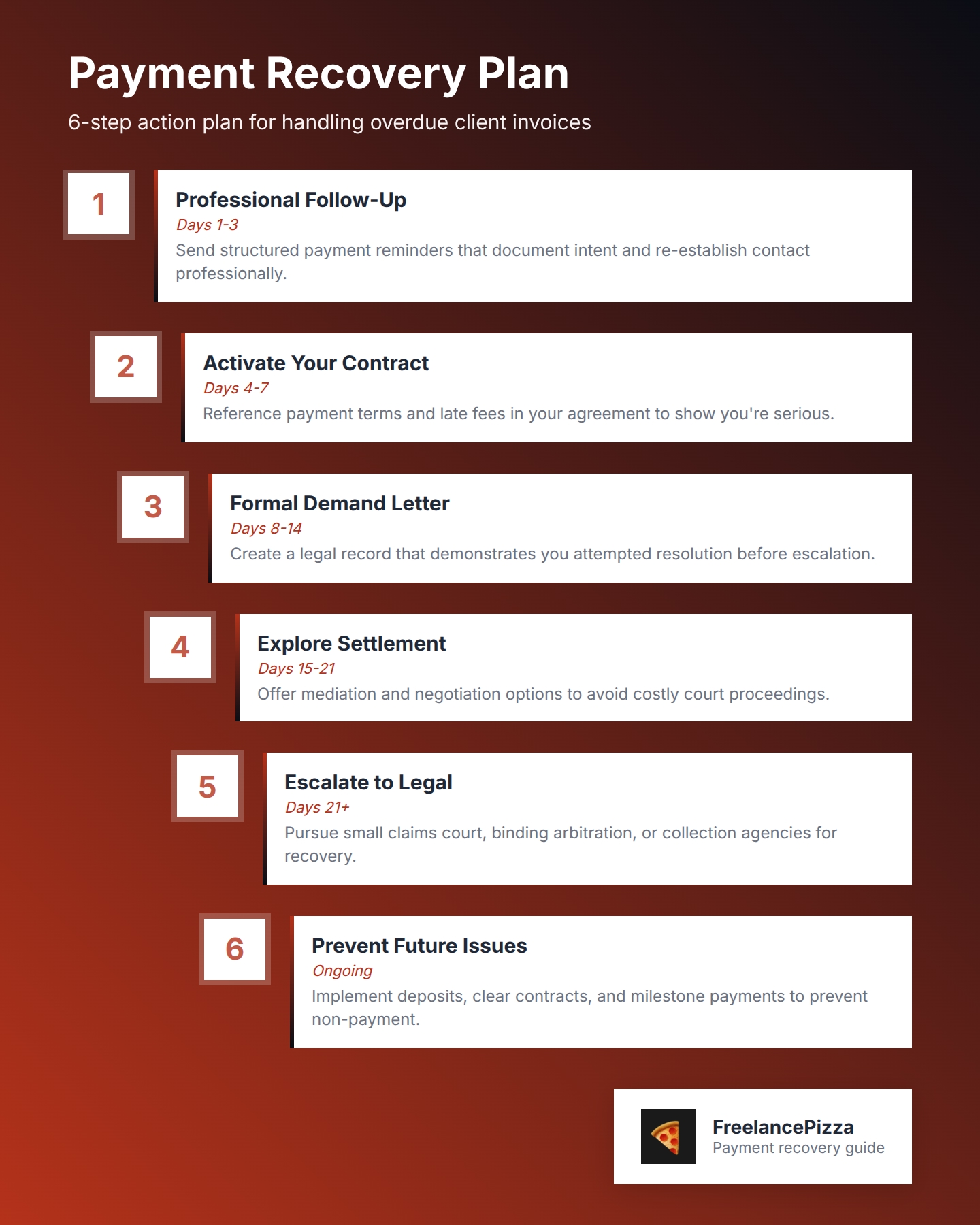
Get the ChecklistBefore going to court, consider mediation or negotiation. These options are faster and cheaper than litigation.
What to Do:
Offer the client a chance to settle the dispute through mediation or a payment plan.
Why This Matters:
Ruul reports that mediation and arbitration are quicker and less expensive than litigation. The Roanoke Star confirms that these options cost less and resolve faster than formal court proceedings. Alfa Law Firm notes that mediation can preserve working relationships while resolving disagreements.
How to Do It:
Send a message offering options:
I'd prefer to resolve this without legal action. I'm willing to discuss a payment plan or mediation. Please respond within 3 business days to arrange a solution. Otherwise, I'll proceed with small claims court or a collection agency.
Common Mistakes:
Expected Outcome:
Some clients will agree to payment plans. Get any agreement in writing. If the client continues to ignore you, it's time for Step 5.
Success Indicator:
You've given the client every reasonable opportunity to resolve this professionally. You're now justified in escalating.

If nothing else has worked, you have three main options: small claims court, binding arbitration, or collection agencies.
What to Do:
Choose the option that makes sense for your situation.
Small Claims Court:
According to Ruul, small claims court is accessible for lower-value disputes. It typically handles claims from a few hundred to several thousand dollars (varies by state).
Filing fees are usually low. You don't need a lawyer. Bring all your documentation: contract, invoices, emails, demand letters.
Binding Arbitration:
Carmine Mastropierro notes that binding arbitration clauses are faster and cheaper than litigation. If your contract includes an arbitration clause, this may be your required next step.
Collection Agencies:
Ruul explains that collection agencies specialize in debt recovery but take a percentage of what they collect. They handle the process for you, but you get less money.
Why This Matters:
You've exhausted reasonable attempts to collect. Legal action protects your right to payment and creates consequences for non-paying clients.
Common Mistakes:
Expected Outcome:
You receive payment, a court judgment in your favor, or you recover a portion of your payment through collections.
Success Indicator:
You receive payment, a court judgment in your favor, or you recover a portion through collections. The Roanoke Star notes that documented contracts provide significant advantages in legal proceedings.
The best way to handle non-payment is to prevent it in the first place. Here's how to set up systems that minimize future risk.
What to Do:
Implement these payment protection strategies:
Get Deposits:
Carmine Mastropierro recommends that deposits and milestone payments reduce non-payment risk. Require a deposit upfront before starting work.
Use Clear Contracts:
Every project needs a written agreement. The Roanoke Star emphasizes that documented contracts provide significant advantages in legal proceedings.
Your contract should include:
Build in Arbitration Clauses:
Carmine Mastropierro suggests that binding arbitration clauses make resolution faster and cheaper. Clear payment terms are critical to preventing disputes.
Use Milestone Payments:
Break large projects into phases with payment due after each milestone. This limits your exposure if a client stops paying. Carmine Mastropierro confirms that milestone payments reduce non-payment risk.
Common Mistakes:
Expected Outcome:
You'll dramatically reduce non-payment incidents. When they do happen, you'll have clear documentation that makes recovery easier.
You'll know your prevention system is working when:
"The client says they didn't receive the invoice."
Resend it immediately with delivery confirmation. Keep records of all sending attempts.
"The client disputes the quality of work."
This is why documentation matters. JustAnswer's legal experts recommend escrow arrangements for disputed deliverables. Review your contract's dispute resolution clause.
"The client agrees to pay but keeps missing deadlines."
Get the new payment date in writing. If they miss it again, proceed immediately to the next escalation step.
After implementing this action plan:
For ongoing protection, Carmine Mastropierro mentions that services like LegalShield offer affordable alternatives to hiring lawyers for contract review and collection support.
Non-payment doesn't have to derail your freelance business. With this action plan, you can handle late payments professionally and protect your income.
The key is acting quickly and following a system. Most clients will pay after professional follow-up. For those who won't, you have clear escalation options.
Remember: you did the work, you deserve to be paid. Following this plan shows you're a professional who takes payment seriously.
Now go set up those prevention systems so you spend less time chasing payments and more time doing the work you actually love.
Join 20.000+ freelancers in our weekly value bomb, and grow your frelance income with confidence!
By entering your email address you acknowledge to subscribe to the FreelancePizza mailing list.
You will be sent a confirmation (opt-in) email to confirm your email. You can unsubscribe any time.
